
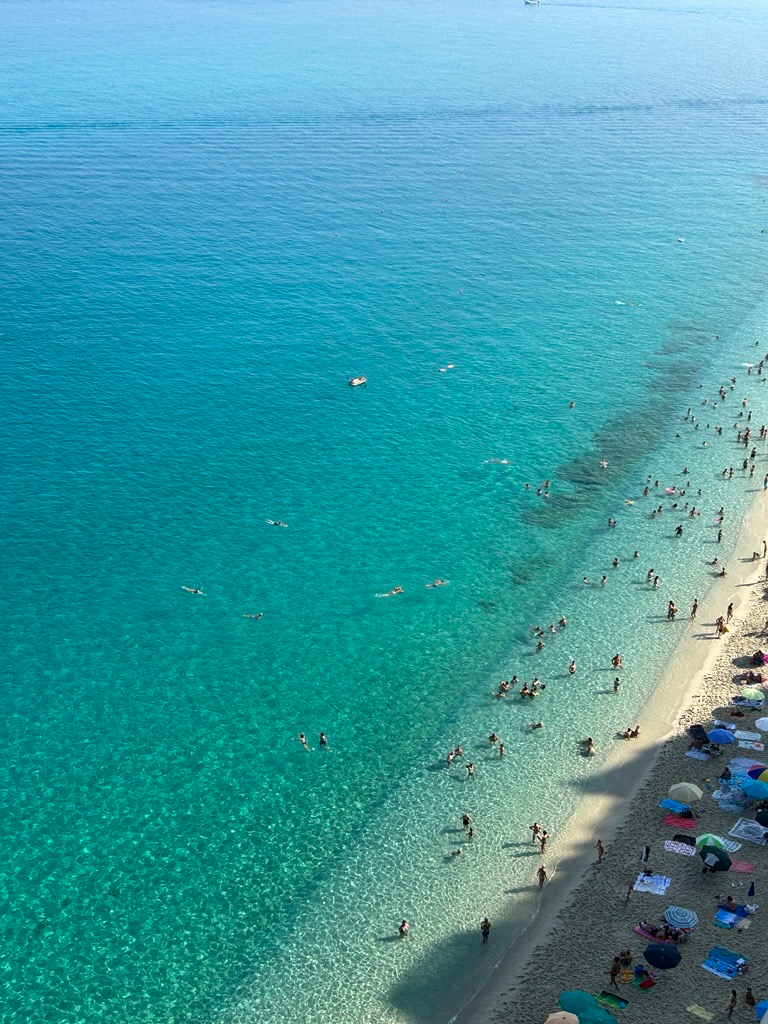

There are mornings in Tropea when you walk to the edge of the old town, look out over the Tyrrhenian Sea, and genuinely forget what you were going to do next. The light hits the water in a way that doesn’t seem real, the sand below is so white it almost hurts to look at, and the Sanctuary of Santa Maria dell’Isola just sits there on its rocky promontory like it has been
waiting for you specifically. And then, on the horizon, so far out it takes a second to register: Stromboli. An active volcano. Just sitting there. On a Tuesday morning, while you’re finishing your coffee.
Nobody warned you it was going to be like this.
Tropea sits on a cliff above the sea in Calabria, on a stretch of coastline locals call the Costa degli Dei, the Coast of the Gods. That name gets thrown around a lot in Italy, but here it actually fits. The water shifts from pale jade to deep turquoise depending on the hour. White tufa cliffs drop straight down to hidden coves. The old town is a tangle of narrow stone lanes, crumbling noble palazzi, and terraces that open suddenly onto views that make you grab whoever is next to you. In 2021 it was named Italy’s Borgo dei Borghi, the most beautiful town in the entire country. Condé Nast and Vogue Italia and Travel + Leisure have all been sending people here recently. American travelers, for the most part, still haven’t caught on, and that is genuinely their loss.
What makes Calabria different from the rest of Italy, and Tropea different from the rest of Calabria, is harder to put into words than the scenery. It’s the people. Calabrians treat visitors not as a necessary inconvenience or a transaction, but as actual guests, in the old-fashioned sense of the word. You sit down at a table and someone takes care of you. You ask for directions and end up with a ten-minute conversation and a recommendation for a restaurant that isn’t in any guidebook. It’s an openness that feels entirely genuine because it is, and it is the single thing that every single person mentions when they come home, above the beaches, above the food, above everything.
Speaking of the beaches: Spiaggia della Rotonda and Marasusa sit directly below the old town, white sand and water so clear that at waist depth you can count every pebble underfoot, with the clifftop silhouette of the town above you as a backdrop that no camera actually captures properly. You just have to be there. Further along, Capo Vaticano gets wilder and quieter, hidden coves and sea caves and views that stretch all the way to Sicily on a clear morning. This is also, not coincidentally, the birthplace of Amaro del Capo, which you will absolutely be drinking by your second night.
And then there are the Aeolian Islands, which most people don’t realize are a two-hour boat ride from Tropea’s port. The day starts on Panarea, the smallest and most effortlessly chic of the islands, whitewashed and unhurried, with the ancient ruins of Capo Milazzese above the swimming cove of Cala Junco. Make sure to stop at

Hotel Raya for lunch or an aperitivo on its legendary terrace; it is one of those places that has been iconic for decades and still earns it, with views over the water and an atmosphere that makes you want to cancel whatever comes next. Then, in the late afternoon, the boat moves on to Stromboli, where the whole tone shifts: black sand, a quiet fishing village, and then after dark, the Sciara del Fuoco, the slope of the volcano where lava actually flows down into the sea while you watch from the water, close enough to feel the heat on your face. It is one of those experiences that you find yourself unable to describe properly afterward, not because nothing happened, but because too much did…
Now, lets talk food. Calabria doesn’t get nearly enough credit and Tropea is where you understand exactly why that’s a shame. The cipolla rossa di Tropea, the local red onion with its own IGP certification and a sweetness that has no business coming from an onion, shows up everywhere here: raw in salads, slow-cooked into a jam with aged cheese, folded into sauces, scattered on pizza, and yes, as a gelato on the Corso that sounds completely wrong until you’re halfway through it and reconsidering everything you thought you knew. Then there’s ‘Nduja, which comes from nearby Spilinga, that fiery, brick-red spreadable salami that every chef in the world has been trying to work into their menu for the past decade; here you eat it the way it was meant to be eaten, on bread, in pasta, on pizza, without any fuss. And filleja alla tropeana, the local hand-rolled pasta with zucchini, eggplant, tomato, and red onion, is the kind of thing you order once and then order again two days later because you keep thinking about it.
For dinner (the best part of the day) Vecchio Granaio does outdoor tables in a stone piazza and makes filleja and ‘nduja pasta and wood-fired pizza that taste exactly like the place they come from. Incipit is where you go when you want Calabrian ingredients treated with a more considered hand, and De Minimi, in the Michelin guide and in the beautiful Villa Paola Hotel, is quietly doing some of the most interesting southern Italian cooking in the region. Deodato is perched above the sea and the view alone is worth the reservation, but the food holds up too; go at sunset, order the ‘nduja, stay until the lights of the town come on. Lastly, Sunset Beach is the beach club that does dinner well, for days when you want to go straight from swimming to eating without the interruption of going back to the hotel.
On the hotel front, Villa Paola is a 16th-century monastery now part of Small Luxury Hotels has only twelve rooms, an infinity pool over the sea, and gardens so overgrown with wisteria and jasmine and bougainvillea that the whole place smells extraordinary. It doesn’t feel like a hotel. It feels like staying at the home of someone who has extremely good taste and genuinely wants you there. Infinity Resort sits on a headland with fifty-two quietly chic rooms, a cliffside pool and terrace that have been photographed by everyone who has ever stayed there, and a private beach at the bottom of a winding path that adds just enough drama to every swim. Palazzo Mottola is for the historically inclined: an antique aristocratic residence built into the rock above the sea in the heart of the old town, Vietri ceramic floors, a Turkish bath, and a rooftop terrace with views from the Aeolian Islands to Santa Maria dell’Isola. And Capovaticano Thalasso Resort near the cape itself offers a full thalassotherapy spa and private beach access for those who want to spend a week doing absolutely nothing and feel great about it.
Here is the honest version of why you should go now. Tropea is not some secret that nobody knows about; Italians have been going for years, and the international press has been arriving steadily. But for Americans planning luxury travel to Italy, it is still genuinely, almost inexplicably overlooked. Right now the hotels are excellent, the food is exceptional, and you can still sit on a beach in August and hear yourself think. That will change, these things always do. Yet, the warmth of the people won’t change, because that isn’t a product of tourism levels or trend cycles; it’s just who Calabrians are. But the quiet streets and the unhurried pace and the feeling that you found something before everyone else did? That part has a limited run.
Go while Stromboli still glows on the horizon like it’s doing it just for you.
Contact The Italian Concierge to start planning your luxury travel to Italy, including custom Calabrian itineraries built around Tropea, the Costa degli Dei, and private day trips to the Aeolian Islands.