
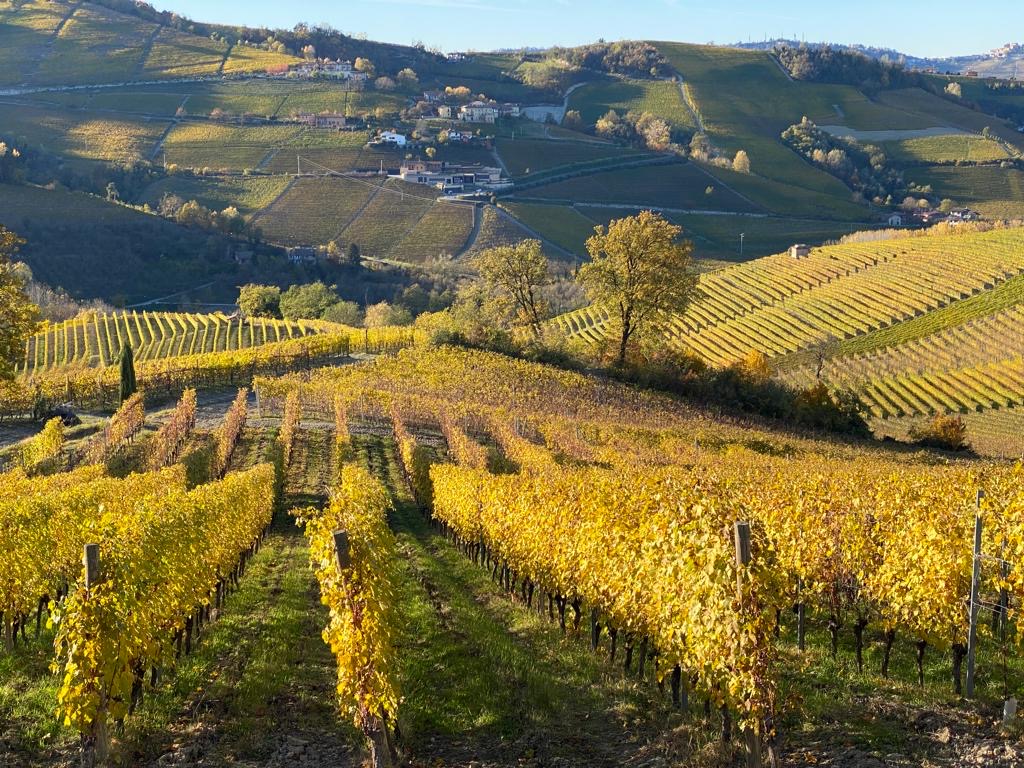

The Langhe are located in the southern part of Piedmont, close to the Maritime Alps and the Ligurian Apennines, straddling the provinces of Cuneo and Asti.
The name, which is of Celtic origin, means “strips of land” and refers to the elongated hills running parallel to each other to form many deep and narrow valleys. The Langhe area is one of the richest regions in the world for the quality and variety of wine production.
Traces of wine plantations have been found in the territory dating from the 5th century BC, when Piedmont became a space of contact and exchange between the Etruscans and the Celts.
The Ligurian tribes founded the town of Alba, the Langhe capital, as an important crossroad along the trade routes of the region. Around the 2nd century BC the Romans defeated the Ligurians and in 89 BC rebuilt Alba as a military settlement with the name of Alba Pompeia. The Romans brought development to the site, improving the winemaking techniques; Alba became an important market town, connected to the other Roman cities of the area, Acqui Terme and Turin.
After the fall of the Western Roman Empire, the city was sacked by the Burgundians in 490 and later by the Lombards, Franks and Saracens. During the Middle Ages Alba was reborn and experienced its time of glory. In this period more than one hundred tall towers were erected, to protect the inhabitants but also as a symbol of their prestige and richness; only a few of them still exist.
For centuries the Langhe were disputed among the Houses of Visconti, Gonzaga and Savoy, all attracted by the regional productivity.
In 1631 the Savoy were able to acquire the entire region and in the 19th century they supported the production of the famous Barolo wine, making the area known in Europe.
During the Second World War the Langhe were the scene of the partisan resistance struggle, described in the novels of Beppe Fenoglio, famous Italian writer born in Alba.
The Langhe experienced a significant economic boost in the late 20th century, largely due to the growing popularity of its wine, hazelnut and truffle industries, paired with the renovation of farmhouses and castles, agritourism, and ethnographic museums.
In 2014, the Langhe (along with Roero and Monferrato) was declared a UNESCO World Heritage Site. This designation recognizes the area as an “outstanding living testimony to the historical tradition of grape growing, winemaking processes, and a social, rural context and economic fabric based on wine culture.”