

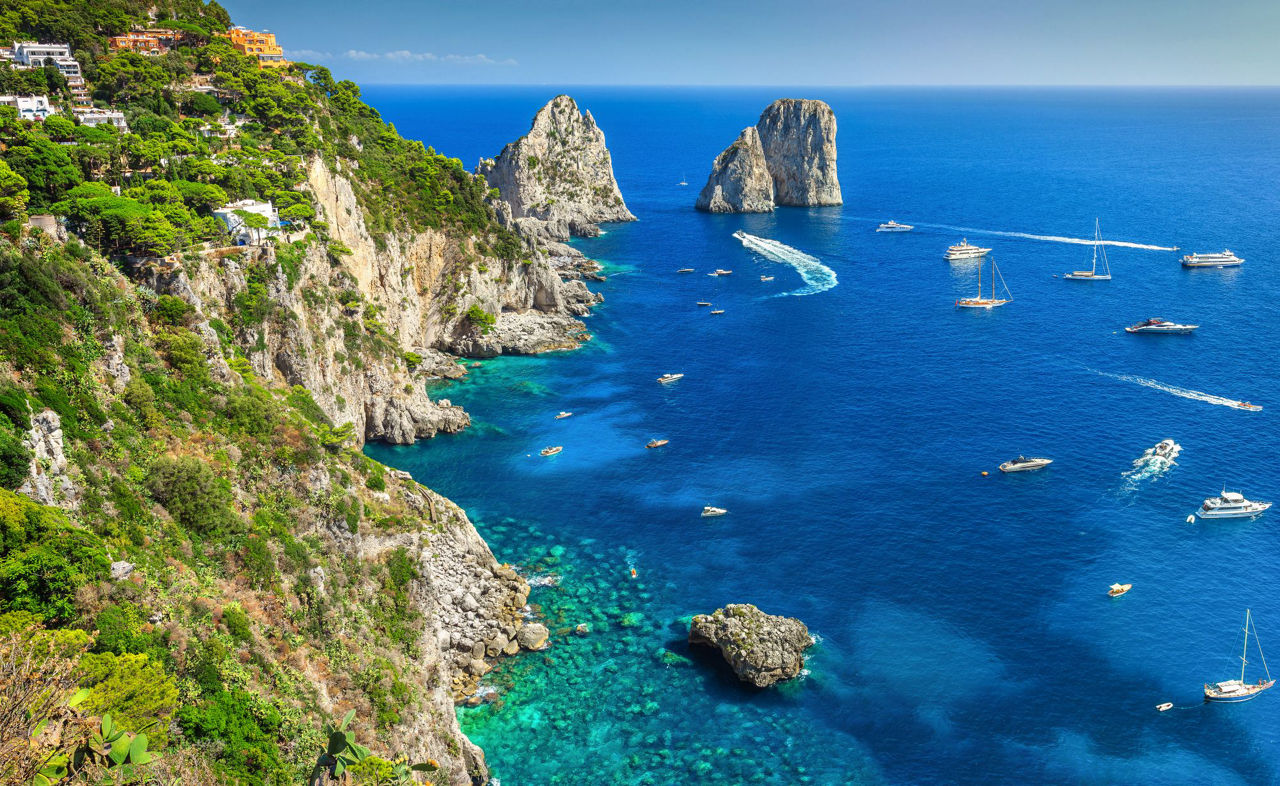
Capri and Ischia are part of the Campanian archipelago, which lies on the edge of the Gulf of Naples in the Tyrrhenian Sea.
Ischia, the largest of the Phlegraean Islands, has a volcanic origin. Following Greek mythology, its birth is linked to the myth of Typhoeus, the giant defeated and stuck under the island by Zeus. It is almost entirely mountainous with rich vegetation and characteristic vineyards. The highest peak is Mount Epomeo, and the volcanic activity has given rise to numerous thermal springs renowned for their therapeutic properties.
Capri is made of limestone. Its lowest part is at the center, while its sides are high and mostly surrounded by precipices with numerous caves. The western area is dominated by the slopes of Monte Solaro, while the east is dominated by Monte San Michele.
During ancient times, both islands were inhabited by Greeks who founded wealthy colonies.
Ischia, known as Pithecusae, became a crossroads of the main trade routes of the Mediterranean, an emporium frequented by the Etruscans, Phoenicians, and Italics. The presence of natural resources and the development of craft activities such as metalworking and pottery production (particularly wine amphorae, as testified by the famous “Nestor’s Cup”) contributed to its prosperity.
After Greek domination, Capri, whose name comes from the Latin capraeae (goats), became a Roman colony, and Emperor Caesar Augustus built his villa here. Emperor Tiberius spent the last ten years of his life on Capri and built twelve villas, the best known being Villa Jovis, whose impressive remains are still visible. The numerous ancient cisterns show that in Roman times rain provided the island’s water since it has no natural springs.
Ischia was also controlled by the Romans, who changed its name to “Enaria,” meaning “Land of Wine” due to its excellent products.
After the collapse of the Western Roman Empire, the islands entered Byzantine dominion but suffered Saracen raids, which forced the inhabitants to build fortresses. In the following centuries, they shared their destinies with Naples, being dominated by the Normans, Angevins, Aragonese, and finally the Spanish, who governed southern Italy.
In the 19th century, the Bourbons, who ruled the Kingdom of the Two Sicilies, promoted excavation campaigns, leading to the discovery of Villa Jovis.
The discovery of the Blue Grotto, the former pool of Emperor Tiberius, in 1826 by German writer August Kopisch and painter Ernst Fries brought the grotto to global attention, transforming it into a famous destination, particularly for tourists on the Grand Tour.
Today, Capri is considered a luxurious and elegant island due to its world-class hotels, high-end shopping and dining, and dramatic natural beauty.
Ischia is renowned for its thermal baths, promoted in the 1960s by publisher Angelo Rizzoli, who opened Ischia to large tourist flows, consolidating thermal therapies in body care. He built the luxury hotel Regina Isabella in 1956 and produced a film, Vacanze a Ischia, helping to establish the island as a glamorous and desirable tourist destination.